
Writing & publications

Books & Publications

Two poetry chapbooks that turn toward memory, art, and the complexities of loss.

Two unmarked poetry chapbooks, a manuscript, and a pen by a sunlit window
Cover of The Ribbon Around the Bomb

Poetry chapbook

The Ribbon Around the Bomb

Elizabeth Levine

Dramatic monologues imagining the final thoughts of writers and artists, reflecting on art, grief, and memory.

Finishing Line Press · February 2019 · 44-page paperback

Reviews

Press and publisher endorsements

These are short excerpts from the book’s press releases and publisher page, not full independent reviews. Each card links to its original source.

“These intimate yet dramatic monologues, steeped in human tribulation, resonate with insight and compassion.”
John ParrasAuthor of Dangerous Limbs; editor of Map LiteraryRead at source
Maria Mazziotti GillanPortrait: Joe Costa
“Elizabeth Levine’s poems are passionate and unforgettable explorations of a woman artist’s life and psyche.”
Maria Mazziotti GillanAmerican Book Award recipient; director, PCCC Poetry CenterPortrait: Joe CostaRead at source
“Where one language fails, another intervenes, until poem after poem she is beating all her wings.”
Martha WittProfessor; author of As Broken As Things AreRead at source
“The title poem alone is worth the price of this compelling book.”
Laura BossPoet and editor of LipsRead at source
“Levine, daring and defying presumption, and spirit-like, enters them, talks through them, each and everyone, to us.”
Frank NiccoletiProfessor; Wight FoundationRead at source
“Elizabeth’s work takes her reader’s to church in a desert of red sand.”
Dimitri ReyesPoet and writerRead at source

For a separate, independent review: Read Dimitri Reyes’s full review in Empty Mirror

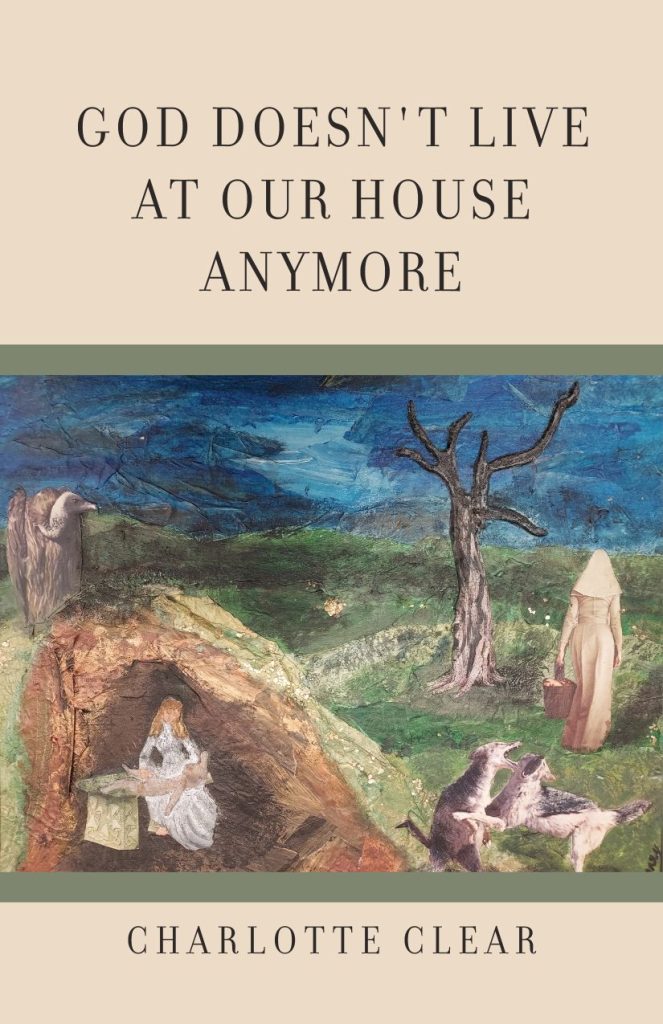
Cover of God Doesn’t Live at Our House Anymore

Poetry chapbook

God Doesn’t Live at Our House Anymore

Charlotte Clear (Elizabeth Levine’s pen name)

A poetry chapbook tracing love, loss, and the long, non-linear experience of grief.

Finishing Line Press · December 2023 · 40-page paperback

He says in the morning or in the night,

God doesn’t live here anymore.

I say to him, there is no God.

He is not even eight years old.

From the title poem, “God Doesn’t Live at Our House Any More”

Reviews

In readers’ words

Reviews from the book’s original site and Finishing Line Press. Elizabeth’s own note and review excerpts are identified separately.

Maria Mazziotti GillanPortrait: Joe Costa

Maria Mazziotti Gillan

Poet and American Book Award recipient

Portrait: Joe Costa

In “God Does Not Live at Our House Anymore”, the poet Charlotte Clear gives us an exploration of grief and loss, of the dissolution of a marriage and the way grief is like a sledgehammer in our lives. These poems are brutally honest clear sighted and unforgettable.

Read at source
Tara Moyle

Tara Moyle

M.F.A., L.P.C. · Educator, mental health counselor and poetry instructor, Montclair Adult School

Charlotte Clear’s unflinching, relentless meditation on profound loss is delivered to readers in lines that are at once controlled and full of chaos. In God Doesn’t Live at Our House Anymore, we’re reminded of the confessional poets, brazenly raw. Here, though, the confessional aspect might speak to the various ways the narrator detaches from her life: “I stop noticing things.”

While the narrator may stop noticing, though, the poet keeps watch. Loss becomes not only visible but also part of a crucial voice. Even as the narrator insists she is numb, there’s so much feeling in these poems. Without Levine’s tender skill, the bare primal self could not be so realized.

Read at source
Elizabeth Levine

Elizabeth Levine

M.A., M.P.H., M.F.A. · Author’s own note on the book site

From the author’s site

In this breathtaking debut chapbook, Charlotte Clear’s poetry takes on a brutal and heartfelt journey after the death of her daughter. For anyone who has struggled with grief or bereavement, this painstakingly honest chapbook documents not only the poet’s recovery, but speaks to the universality of love, loss, and regret; and the long, circular route she endures on her road to healing.

Charlotte Clear describes in her chapbook the weight of the days in the aftermath of the labyrinth of grief. Her poems are powerful examples of the complexity of life, love and loss in exquisite detail. This is a must-read for those who are struggling with loss of a loved one.

Read at source
Valerie Mich’El Oliver

Valerie Mich’El Oliver

M.P.S. · Author and editor

I’m not a parent and have never been pregnant, so people might wonder what possible value reading this poetry would have for someone like me.

I knew I made a good decision to read “God Doesn’t Live At Our House Anymore” when a flood of tears streamed down my face and I couldn’t stop sobbing about halfway into reading this chapbook. It was this one line:

My baby girl, Charlotte.

My outpouring was mingled with my own submerged grief about being an abused child–my own “Little Girl”. I realized how those abusive experiences led to a silent decision made years ago to never have children of my own for fear of hurting them. I’m grateful for the powerful breakthrough understanding that came from reading this chapbook.

Read at source
Carney Mimms

Carney Mimms

Montclair Write Group

Charlotte Clear’s poems, collected in “God Doesn’t Live at Our House Any More”, are songs of pain and torment as exquisite as they are hard to bear. Levine presents the reader with a lyrical challenge. How far down will you go with her and what will you lose along the way; your love, your life, your soul and at very bottom of it all, your beloved child?

Levine speaks of “complicated grieving” without a trace of self-pity yet full of piercing regret. There are no easy calls for forgiveness and or paths to redemption. Her anguish is visceral and palpable. Levine leads the reader to many uncomfortable truths in facing inexplicable tragedy.

Read at source

Rick Gilman

Reader review on Finishing Line Press · 5 out of 5 · May 23, 2026

Review excerpt

These poems form a raw, unflinching portrait of domestic life, marriage, and the quiet ache of endurance.

Read at source